
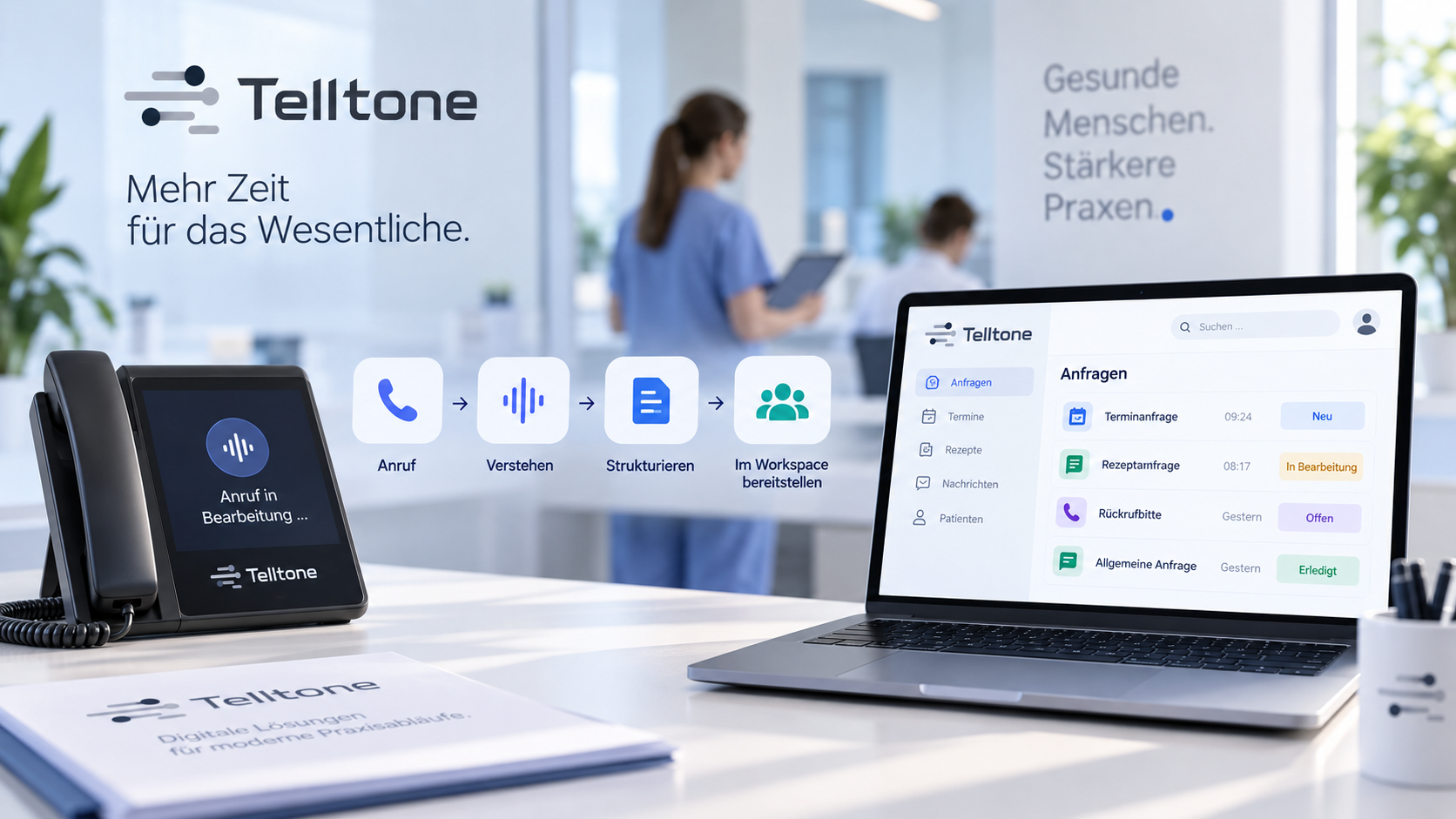
An AI phone assistant answers calls in a medical practice, understands the request in natural language, and captures it in a structured way for the practice team, including outside opening hours.
This article explains how that works in practice, from the incoming call and structured capture to the handoff to the practice team. We use Telltone Relay to walk through the process step by step.
What is an AI phone assistant for a medical practice?
An AI phone assistant is a digital assistant that answers patient calls and captures administrative requests.
Patients describe their request in their own words. The assistant asks the necessary follow-up questions, summarizes the information, and makes it available to the practice in a structured form.
The boundary is important: this is administrative communication.
Medical advice, diagnoses, interpretation of test results, and decisions about medication, dosage or treatment remain with qualified medical professionals.
How does it work step by step?
1. The call reaches Relay
The practice receives a dedicated Telltone number through Workspace and sets up call forwarding to it. The existing practice number remains in use.
2. Relay greets the patient
Relay answers using the greeting configured for the practice and uses the configured practice information.
3. The patient explains the request
The patient describes the request naturally. Relay asks the follow-up questions required to capture the necessary administrative information.
4. The request is captured in a structured form
The conversation becomes a structured request rather than simply an unstructured call note.
5. The request enters Workspace
The practice team can review and process it there. Depending on the service and configuration, the team confirms the next step or an explicitly enabled automated workflow continues.
What happens when a patient calls?
The patient is greeted and can state the request directly.
Relay conducts the conversation, identifies the type of administrative request, and collects the information required for that workflow.
For an appointment request, that might include the requested appointment, service, or appointment mode. For a prescription request, Relay collects the administrative information configured for that request.
A binding appointment confirmation is given only after the appointment has actually been booked successfully.
Which requests can Relay capture?
Relay is designed for recurring administrative patient requests.
These include:
- Appointment requests: including information such as the reason, service, and whether the appointment is requested in person, by phone, or as a home visit.
- Prescription requests: administrative information for a repeat-prescription request, such as medication and pharmacy, for the practice team to review. Dosage information is not collected.
- General requests and callbacks: questions, callback requests, and other administrative messages can be captured in a structured form.
The exact requests and workflows available depend on the practice's configuration.
What happens after the conversation?
The request appears as a structured record in Telltone Workspace.
The practice team can see what the request concerns and continue processing it.
The important difference from a simple voicemail or generic inbox is structure: the relevant information is captured as an actionable record for the team.
What can the practice automate and control?
The practice decides how each service should work.
Team confirmation
This is the default. Relay captures the request, and the practice team reviews and confirms the next step.
Automatic booking
For services explicitly enabled for automatic booking, Relay can check actual availability, book the appointment, and confirm it only after the booking succeeds.
Automatic booking is therefore not a blanket setting for every request. The practice decides which services may use automated workflows.
What happens when Relay should not handle something?
Not every request should be handled automatically.
Requests that should remain with the practice team are handed over for further processing.
The medical boundary also remains clear. Relay does not provide medical advice, make diagnoses, interpret test results, or decide about medication, dosage, or treatment.
Those responsibilities remain with qualified medical professionals.
Can several patients call at the same time?
Yes. Relay is designed to support multiple concurrent requests rather than being limited to a single simultaneous telephone conversation.
That can be particularly useful during periods of high call volume.
“Multiple at the same time” does not mean unlimited. Technical capacity is controlled and bounded.
Does the practice need a new phone system?
No.
The practice receives a dedicated Telltone number through Workspace. The existing practice number is then connected to Relay through call forwarding.
The familiar practice number can remain in place. A new telephone system is not required for this model.
What about data protection?
Patient communication contains sensitive information. A practice should therefore evaluate not only functionality but also how data is processed and protected.
Telltone is developed in Germany and hosted in the EU. Data is encrypted in transit and at rest, and organizational data is processed with tenant isolation.
Conversation transcripts are stored only when the practice explicitly enables that function.
What does an AI phone assistant cost?
Cost depends on the provider, pricing model, and level of usage.
With Telltone Relay, the plans are structured partly around included voice hours.
For a detailed explanation of pricing models, ongoing costs, and the current Relay plans, see our article “How Much Does an AI Phone Assistant for a Medical Practice Cost?”
Is an AI phone assistant right for every practice?
An AI phone assistant can be particularly relevant where phone calls regularly interrupt reception, where many recurring administrative requests arrive, or where patients need a way to submit requests outside opening hours.
The actual benefit depends on call volume, practice workflows, and which processes the practice chooses to automate.
Blanket promises about hours or money saved would therefore be misleading.
Conclusion
An AI phone assistant can capture administrative patient requests, structure them, and hand them to the practice team without taking over medical decisions.
The practice retains control over which workflows require team confirmation and which are explicitly allowed to run automatically.
See how Telltone Relay applies this approach for medical practices on our AI phone assistant for medical practices page.