
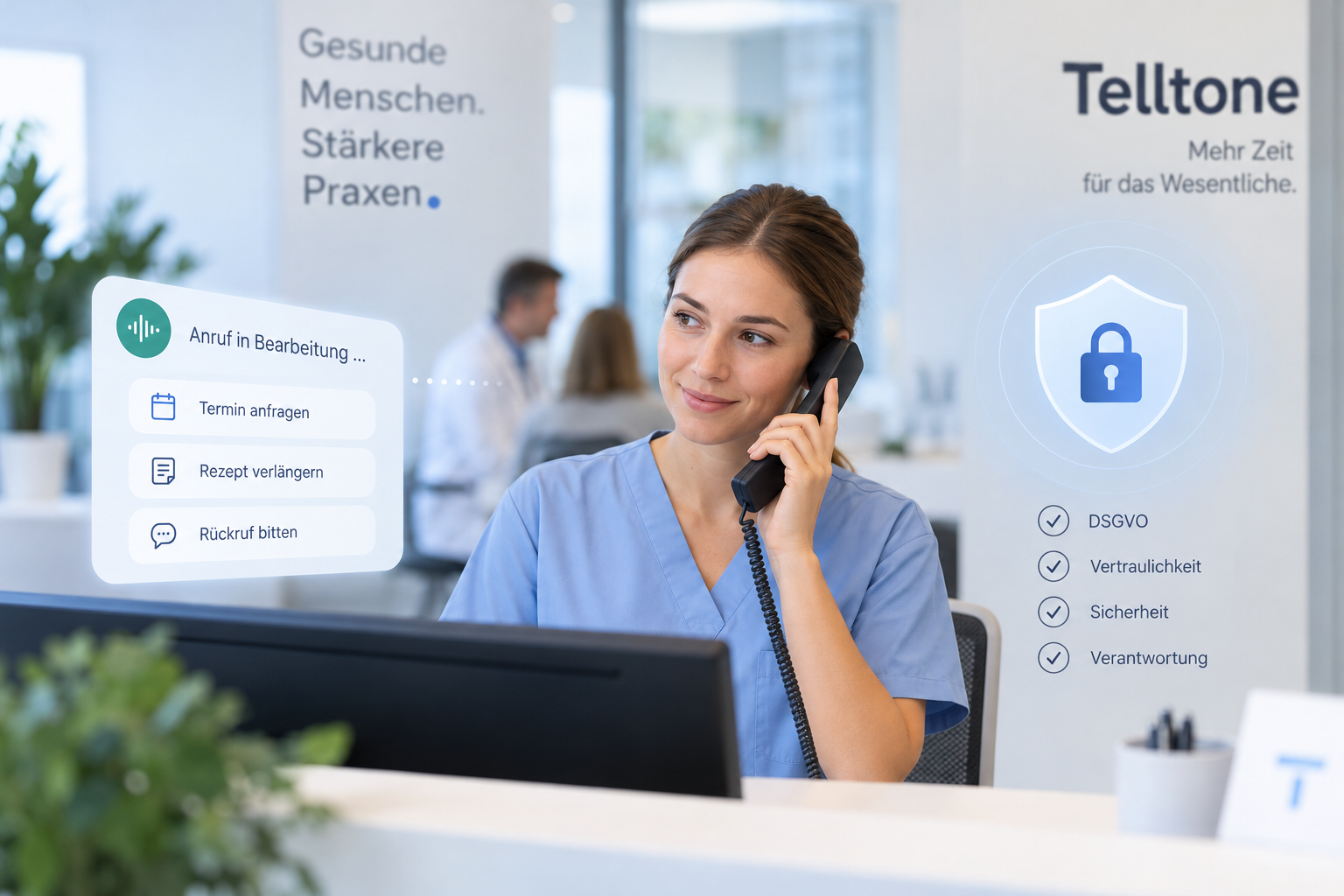
An AI phone assistant can answer patient calls, capture administrative requests, and help medical practice teams manage recurring communication tasks. In doing so, it may process personal information that requires special legal protection.
This raises an important question: Under what conditions can a medical practice use an AI phone assistant while meeting its data protection obligations?
The answer involves more than the location of the servers or the AI technology used. Legal responsibilities, patient confidentiality, service providers, technical safeguards, and the handling of patient requests all matter.
Why does data protection matter?
Even an ordinary patient phone call can contain sensitive information.
A patient might request an appointment relating to a medical condition, ask for a repeat prescription, or request a callback concerning treatment.
Although an AI phone assistant may perform only administrative tasks, it can still process health data protected under Article 9 of the GDPR.
Medical practices must also consider professional confidentiality and applicable national laws.
The entire data-processing workflow must therefore be evaluated, not just the assistant's individual features.
Which legal requirements apply?
Several legal frameworks may be relevant.
1. General Data Protection Regulation (GDPR)
The GDPR governs the processing of personal data. Health information is subject to additional protection, including the requirements of Articles 6 and 9.
2. Medical confidentiality
Medical professionals have confidentiality obligations. When external service providers are involved, applicable professional rules and national confidentiality laws must also be considered.
3. Data processing agreements
Where a provider processes personal data on behalf of a practice, an agreement under Article 28 GDPR may be required.
4. Technical and organizational security
Article 32 GDPR requires security measures appropriate to the risks, potentially including encryption, access restrictions, authorization controls, and other safeguards.
Is patient consent always required?
No. Patient consent is not automatically required for every processing activity performed through an AI phone assistant.
Medical practices may have other applicable legal grounds for processing patient information in connection with healthcare services.
Likewise, using a properly appointed processor does not, by itself, always require separate patient consent.
However, the practice must evaluate the specific processing activity.
Important questions include:
What is the applicable legal basis?
Which health-related information is processed?
Which service providers can access the data?
Are calls recorded or transcripts stored?
Is information used for additional purposes?
How are patients informed?
Call recording may involve additional legal requirements. A legal basis for handling an administrative request does not automatically authorize recording the conversation.
Who is responsible for patient data?
In a typical arrangement where a medical practice engages a service provider to process patient requests on its behalf, the practice remains responsible for the lawfulness of that processing.
The provider may act as a data processor.
The actual allocation of roles depends on who determines the purposes and essential means of processing.
Practices should evaluate whether the provider:
processes patient information only for agreed purposes,
follows documented instructions,
implements appropriate safeguards,
identifies additional service providers,
supports deletion and retention requirements,
assists with applicable data protection obligations.
A processing agreement is important, but the actual technical implementation must also be consistent with it.
Where is information processed and stored?
Server location matters, but it is not the only consideration.
EU hosting alone does not establish GDPR compliance.
A medical practice should understand which organizations are involved and whether information is transferred or accessed outside the European Economic Area.
Storage, AI processing, telephony, and technical support may involve different providers or processing locations.
The practice should ask where information is stored, where speech processing occurs, which cloud and telephone providers are involved, and whether international transfers require additional safeguards.
Are patient calls recorded?
Processing spoken information and permanently storing a call recording are different activities.
An AI assistant may process speech to understand an administrative request. Whether audio recordings, transcripts, or other conversation information are retained depends on the service and its configuration.
A practice should establish:
whether complete audio recordings are stored,
whether transcripts are retained,
what structured information remains after the call,
who can access it,
how long it is retained,
how deletion is handled.
Any recording functionality must be evaluated under the applicable legal requirements. Informing a patient that an AI assistant is in use does not necessarily replace consent that may be required for recording.
Why does practice control matter?
Data protection is not limited to encryption and storage.
An AI phone assistant should be configured to collect and process information necessary for the intended administrative purpose.
Telltone Relay's operating model captures administrative requests as structured records in a shared Workspace.
Depending on the service configuration, the practice team can confirm a request or explicitly enable an automated workflow.
The medical boundary remains clear: Relay does not provide medical advice, diagnose conditions, or make treatment decisions.
Separating administrative assistance from clinical responsibilities is relevant to both workflow design and risk assessment.
Is a Data Protection Impact Assessment required?
Under Article 35 GDPR, a Data Protection Impact Assessment (DPIA) is required where processing is likely to result in a high risk to individuals' rights and freedoms.
The use of innovative technologies and sensitive health information can be important factors.
This does not mean every AI phone assistant automatically requires a DPIA.
The practice must assess the specific processing activities, their scale, the technology involved, and the associated risks.
Where a DPIA is required, it must be completed before the relevant processing begins.
Data protection checklist before implementation
Before adopting an AI phone assistant, a medical practice should review:
Legal basis: Are the grounds for processing personal and health information established?
Confidentiality: Are applicable medical confidentiality obligations addressed?
Contracts: Are the necessary data processing agreements in place?
Providers: Are service providers and international data flows documented?
Security: Are access controls, encryption, and organizational safeguards appropriate?
Retention: Is it clear what information is retained and when it is deleted?
Patient information: Are patients appropriately informed?
Risk assessment: Has the need for a DPIA been evaluated?
This checklist is a starting point, not a substitute for an assessment of the practice's specific circumstances.
Conclusion
AI phone assistants can support administrative patient communication, but responsible deployment requires more than choosing a provider with EU hosting.
Medical practices need to evaluate legal responsibilities, confidentiality, contractual arrangements, technical safeguards, and the actual data-processing workflow.
Rather than relying on broad claims of GDPR compliance, practices should establish what information is processed, by whom, for what purpose, and under which safeguards.
To understand how Telltone Relay supports administrative patient requests, visit our AI phone assistant for medical practices page.